


Crower History
HISTORY
It started as a one-man, part-time operation making engine parts for himself and his hot rod buddies over 50 years ago. Today it has evolved into a multimillion dollar, multifaceted manufacturing operation, producing high performance engine equipment for a wide variety of applications, including cars, trucks, boats, tractors, motorcycles and antiques.
 Crower Cams and Equipment Company, Inc., is a leading producer of aftermarket camshafts and valve train components. But over the years Crower has developed a more diverse line of products. Today, Crower is the world’s largest manufacturer of aftermarket crankshafts and connecting rods, and the Crower line of clutches has been dominating the drag racing and tractor pulling series for nearly four decades.
EARLY THOUGHTS
Bruce Crower, president of Crower Cams, is the thinking man’s racer, saying, People don’t think as much as they should. If you think hard enough, the answer will come. Born in 1930 to a church going family in Phoenix, Arizona, he has been thinking about, and implementing ways to improve the internal combustion engine for nearly six decades.
During high school, Bruce found that other hot rodders would buy parts that he made for his own ’32 Ford roadster. As new ideas came to mind, instead of making just one part for himself, he would make several at a time and sell them to his fellow hot rodders. It was simple arithmetic to see the profit of making thousands of such parts and selling them nationwide.
 INTRODUCTION TO FAST MACHINES
In 1949, a fast, 80 cubic inch Harley led to a 120 mph, 300 cubic inch Merc-powered Deuce roadster that Bruce says was, the first Arizona car to beat the bikes, and his own successful speed shop near Phoenix, Arizona. Uncle Sam, however, had other plans and he was drafted for the Korean war.
After 18 months on a ground crew in the Air National Guard, developing his mechanical skills in a machine shop at Luke Field Air Force Base, he followed his parents to San Diego and landed a job as a machinist at Paul Schiefer Clutches. All over California, especially at Paradise Mesa, people were burning up the quarter mile.
THE CHRYSLER HEMI
And despite the legendary Bean Bandits’ quantum leap from 120 to 140 mph with a Bruce Crower built engine, the flathead’s reign was over the day Chrysler introduced its OHV Hemi. Bruce was quick to realize the Hemi’s potential, and by 1954 he was shakin’ em up on the Bonneville salt flats with a 157 mph record breaking run behind the wheel of his Hemi-powered Hudson. Credited with being the first to top-mount a GMC blower, Bruce had fashioned his own intake manifold and a pulley system cast in coffee cans using old pistons as material.
THE U-FAB INTAKE MANIFOLD
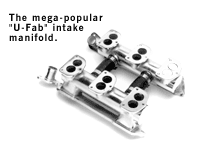
The intake/blower combo was a success, and not only put Bruce in the record books but also in the manifold business. There followed the phenomenally successful Crower U-Fab do-it-yourself manifold. Consisting of two cylindrical runners joined with hoses and clamps, the U-Fab was designed to hold four, six or eight Stromberg carburetors.It was simple, inexpensive and extremely popular. We sold thousands of them, according to Bruce.
1955 - THE BEGINNING OF CROWER EQUIPMENT CO.
With $312 in the bank Bruce booked a sixth page ad in Hot Rod for $300. That one ad generated over $10,000 dollars worth of orders, and suddenly I was, controlling my own destiny with my own two hands, and the harder I worked, the more money I made. He worked until the wee hours of the morning assembling those kits, and finally hired his brother, Dave and eventual brother in-law, Loren in order to keep the production up with the demand. Thus the formation of Crower.
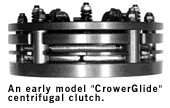
THE GLIDE Other speed merchants eventually followed his lead, tapping into Crower’s market share. But Bruce and the boys had been thinking ahead, this time about a double disc clutch first seen in a Fiat. Crower combined this technology with a Schiefer clutch and applied it towards drag racing and, once again, enjoyed another overnight success with the Crowerglide centrifugal clutch. It quickly became the most popular clutch in drag racing.
CAMSHAFT TECHNOLOGY
Crower, however, was already moving on, this time in the direction of cam technology where once again they took advantage of an industry in low gear. The industry’s shortcomings have always provided the impetus for Crower’s ideas. Only the experiences at the Indianapolis 500 Brickyard have caused him to reevaluate his direction.
THE INDY EXPERIENCE
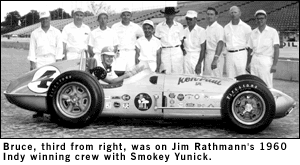
In 1954, Bruce Crower was invited to work on the Offy-powered Dean Van Lines Indianapolis racing car with Jimmy Bryan. They qualified on the front row and finished second. Six years later, working on Jim Rathmann’s team, all of their hard work paid off as they went on to win the 1960 Indy 500. He went on to win again as a member of Graham Hill’s team, and again in 1967 as part of the A.J. Foyt team.
Subsequent years saw Crower cars equipped with engines as diverse as a downsized small-block Chevy and a custom designed flat-eight with Cosworth heads, which received the 1977 SAE Louis Schwitzer Award for race car design. But over the years, in order to remain competitive, teams started preparing year around for the race, and Bruce decided that his time and money would be better spent investing in his own business in the area of high performance engine parts and engine research.
Today, Crower Cams and Equipment Company is still family owned and operated, employing over 200 people in our new 110,000 sq ft building. Utilizing the latest in computer assisted design (CAD), Crower engineers render multidimensional blueprints that are then downloaded into one of Crower’s state-of-the-art CNC machining centers. This allows more flexibility, with tighter tolerances, and gives the customer more choices. Crower offers over 10 different styles of steel billet connecting rods and five different crank designs for the small block Chevrolet depending on the customer’s particular application, rpm range and budget.
RESEARCH & DEVELOPMENT
Although Bruce Crower is no longer involved in the day-to-day manufacturing operation, he spends his time designing and developing new products at the company’s research and development facility located at his Jamul ranch. This R&D facility houses a complete machine shop and a fully operational, computer controlled Heenan-Froude engine dynamometer, capable of generating high levels of horsepower and torque on just about any type of engine. Before Crower introduces a new product to the market, you can be sure it has undergone a rigorous cycle of testing under dyno simulated racing conditions. Each Crower product is then evaluated for maximum horsepower and torque figures, as well as rpm specifications to insure product reliability.

THE BONNEVILLE SALT FLATS
In addition to product testing and development, both of Crower’s Bonneville race cars were completely designed and constructed at the Jamul facility. A 1927 Model-T roadster equipped with a 700hp 1931 straight-8 Nash engine, and a state-of-theart streamliner powered by a turbocharged small block Chevy and a pair of prototype Crower 4-valve cylinder heads. He first touted the idea of a four-valve production head for the small-block Chevy back in 1965 after inventing a head with an inlet port on the same plane as the exhaust port. Chevy engineers were so impressed they had prototypes drawn and cast within 30 days. Unfortunately, the various race sanctioning bodies indicated that they would have to ban it because it would have given certain racers an unfair advantage. The streamliner, however, is in the Unlimited Class and with the help of the heads and some other radical design solutions, it is projected to run over 440 mph at 1150 horsepower on the Bonneville salt flats.
RECOGNIZING HIS DEDICATION
In recognition of Crower’s innovative products for drag racing, Bruce Crower was inducted into the Drag Racing Hall of Fame located in Florida. An honor and privilege that is the direct result of his hard work and dedication to the industry that he loves so much.

USING QUALITY, AMERICAN MADE MATERIALS
The secret to Crower’s lasting success, according to Dave Crower, vice president and general manager of Crower, is that basically we make what people ask for. We do it with better quality than anyone else, plus we do it lighter, which is the key to quicker elapsed times. Not one to compromise the strength and integrity of Crower’s products, Crower uses USA milled materials in its manufacturing. Although cheaper products can be imported from other countries, the Crower philosophy has always been that If a product is made right the first time, using the highest quality materials and the latest production methods, it will perform flawlessly to it’s intended ability.
CROWER TODAY
Crower, a family run business, is proud of its family values. We have staff members that have spent 30+ years with us. We view our employees as family and we thank them for their hard work and dedication. Over the past decades, they were and are an integral part in making Crower what it is today.